As I was reading a site the other day I came across this article... They
say what is not so obvious to most people who decide to learn a new
language, so I suggest that you give it
a quick read. Maybe you are making this
mistake too: “Rigid Thinking” ( that can be understood as not being open to new ways of thinking... each language has its different way of seeing things, phonetics and structuring its sentences...)
Linguists have found
that students with a low tolerance of ambiguity tend to struggle with language
learning.
Language learning involves a lot of uncertainty – students will encounter new
vocabulary daily, and for each grammar rule there will be a dialectic exception
or irregular verb. Until native-like fluency is achieved, there will always be
some level of ambiguity.
The type of
learner who sees a new word and reaches for the dictionary instead of guessing
the meaning from the context may feel stressed and disoriented in an immersion
class. Ultimately, they might quit their language studies out of sheer
frustration. It’s a difficult mindset to break, but small exercises can help.Find a song or text in the target language and practice
figuring out the gist, even if a few words are unknown.
And then I add: be patient with yourrself !!! How many things you really learned in a rush?? Not many... I would say... So , this dedication and effort you put to this new language will come as a reward and will give you at least the independence for communicating with people from a different culture!! That is the dream we are talking about!!! the dream of speaking another language!!
13/05/2016
"The world will see you the way you see you! and treat you the way you treat yourself " Beyoncé And I complement: be good and fair and you will find goodness and fairness!!!
If you are like most people, you probably imagine that people who are organized are more productive compared to messy ones.But this is just because the society has led us all to believe it. Now an increasing number of experts are contrary to this thought. Apparently people whoa disorganized and messy aren't necessarily less productive or lazy... They're just bold and more spontaneous! Actually, messy people are more imaginative!
See for yourself: Authors Eric Abrahamson and David H.Freedman of A PERFECT MESS : The hidden benefits of Disorder explain : "Mess isn't necessarily the absence of order. A messy desk can be a highly effective prioritizing an accessing system.'
On a messy desk the more important , urgent work tends to stay close by and near the top of the clutter( syn. disorder), while the safely ignorable stuff tends to get buried to the bottom or near the back, which makes perfect sense." In other words, a messy desk can boost ( syn. increase) efficiency, depending on the person.
A study by Kathlen Vohs of the University of Minnesota Carlson School of Management, seems to concur (syn. agree). According to it, a cluttered environment helps increase not just efficiency, but also creativity. To explain it : Vohs divided 48 participants into 2 groups and asked them to come up with new ways to use a ping pong ball. One half was placed in a messy room and the other half in a tidy room. Although both groups came up with the same number of ideas, a panel of independent judges determined the ideas produced by those in the messy room were far more innovative.
Vohs explained the finding
thus:
"Being a messy room led to something that firms, industries and societies want more of Creativity. Disorderly environments seem to inspire breaking free of tradition, which can produce fresh insights. Orderly environments , in contrast , encourage convention and playing it safe."
Society expect us to maintain order, in every sense of the word. Disorganized people are labeled as
lazy and ill-bred (syn. implolite and lacking good manners). But the neat, orderly world we strive for is all an
illusion. Organization is a cheat we use to fool ourselves that life isn’t the
random, unstructured, chaotic mess we secretly know it to be.
Physicist Adam Franks explains: “The hard truth is that the universe itself is dead-set
against our long-term efforts to bring order to the chaos in our lives. That’s
because the universe loves chaos.” So , while you might be able to reduce chaos and maintain a semblance ( syn. visual appearance) of order in one small space you control, like your home, the activities you do to maintain that order create more mess for the rest of the universe.
Crazy ???? For example, that trash that you throw away goes to a landfill and contributes to pollution. Think about it !!! Disorganized people might get a bad reputation in society and be considered lazy, but they are not really lazy. The've just seen the light and decided to go with the flow instead of swimming against the current. They would rather fill the bulk(sy. main part) of their limited time in this world with what they perceive as more meaningful tasks for them than spend time on tedious, recurring activities like tidying up.
Of course, there's nothing wrong with being organized. It's just that we also need to recognize that there's nothing wrong with being disoganized either.
Being disorganized is the default (syn. predefined) state. I's a beautiful thing!!!
Hello! I am finally back to bring more ways to learn , I found this questionnaire at Indy 100, quite intriguing, try it and let me know, Click in "questionnaire"...
How empathetic are you? Take this quiz to find out
The Autism Research Centre at the University of Cambridge developed a way to measure your empathy.The questionnaire, which consists of 60 questions, was put together by Simon Baron-Cohen, and can be used to measure the level of social anxieties brought about by disorders like Autism.
Who would say... Emma Watson at UN! Sensational and emotional. I got to know about this video through Isabela Ruiz. Thank you girl !
23/09/2014
DRIVERS, be careful please !!!!!
16/04/2014
interesting comment: Thanks to Neusa Ramaglia!!!!
No English dictionary has been able to explain the difference between the two words 'complete' and 'finished' in a way that's so easy to understand:
Some people say there is no difference between COMPLETE & FINISHED, but there is:
When you marry the right one, you are COMPLETE....
And when you marry the wrong one, you are FINISHED.....
And when the right one catches you with the wrong one, you are COMPLETELY FINISHED !!!
29/10/2013
It is interesting to know how colors can affect us, like language, there are nuances in tone, intent and effect. Check out this infograph, showing how logos use colors to emphasise the core value of their brands.
uses of UP..
You lovers of the English language might enjoy this . .
There is a two-letter word that perhaps
has more meanings than any other two-letter word, and that is "UP."
It's easy to understand UP, meaning toward the sky or at the top of the list, but when we awaken in the morning, why do we wake UP? At a meeting, why does a topic
come UP? Why do we speak UP and why are the officers UP for election and why is it UP to the secretary to write UP a report?
We call UP our friends. And we use it to brighten UP a room, polish UP the silver, we warm UP the leftovers and clean UP the kitchen. We lock UP the house and
some guys fix UP the old car. At other times the little word has real special meaning. People stir UP trouble, line UP for tickets, work UP an appetite, and think UP
excuses. To be dressed is one thing but to be dressed UP is special.
And this UP is confusing: A drain must be opened UP because it is stopped UP. We open UP a store in the morning but we close it UP at night.
We seem to be pretty mixed UP about UP! To be knowledgeable about the proper uses of UP, look the word UP in the dictionary. In a desk-sized dictionary,
it takes UP almost 1/4th of the page and can add UP to about thirty definitions. If you are UP to it, you might try building UP a list of the many ways UP is used.
It will take UP a lot of your time, but if you don't give UP, you may wind UP with a hundred or more. When it threatens to rain, we say it is clouding UP. When the
sun comes out we say it is clearing UP.
When it rains, it wets the earth and often messes things UP.
When it doesn't rain for awhile, things dry UP.
One could go on and on, but I'll wrap it UP, for now my time is UP, so....Time to shut UP.....!
04/06/2013
Here's excellent motivation to keep on studying English, have a look...
Non native-speakers of the language now outnumber native speakers 3 to 1.
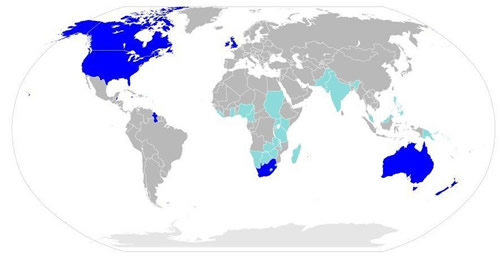
English is spoken as first language by more than 370 million people throughout the world, and is used as a second language by as many, if not more. One in five of the world's population speaks English with some degree of competence. It is an official or semi-official language in over 70 countries, and it plays a significant role in many more. English is not just one standard language, but can be thought of as a "family", which includes many different varieties. The map below shows where English and its varieties are spoken nowadays:
countries with significant concentrations of native speakers of English (in all of these countries English is an official or de facto language of administration)
other countries in which English is an official or important administrative language
Source: Wikipedia, the free Encyclopedia (http://en.wikipedia.org/wiki/Main_Page)
Within a decade, 2 billion people will be studying English and about half the world — about 3 million people — will speak it. Non-native speakers of the language now outnumber native speakers 3 to 1, according to English language expert David Crystal. He recognizes that there is never before been a language that's been spoken by more people as a second language than a first. In Asia alone, the number of English-users has topped 350 million — roughly the combined populations of the United States, Britain and Canada. There are more Chinese children studying English — about 100 million — than there are Britons.
What people use English for
The massive English-learning industry in India alone is a $100 million-per year business. It's the front line of a global revolution in which hundreds of millions of people are learning English, the planet's language for almost every kind of transaction. English is the main language of commerce, technology, communication, science, academic conferences, business, entertainment, airports and air-traffic control, diplomacy, radio, newspapers, books, sports, tourism, international competitions, pop music advertising etc. — and, increasingly, empowerment.
Over two-thirds of the world's scientists read in English. Three quarters of the world's mail is written in English. Eighty per cent of the world's electronically stored information is in English. Of the estimated forty million users of the Internet, some eighty per cent communicate in English, but this is expected to decrease to forty per cent as speakers of other languages get online.
29/06/2012
19 interesting facts, or curiosities... Did you know that :
1. People who ride on roller coasters have a higher chance of having a blood clot in the brain.
2. People with blue eyes see better in dark.
3. Money isn ' t made out of paper, it is made out of cotton.
4. A huge underground river runs underneath the Nile, with six times more water than the river above.
5. A tiny amount of liquor on a scorpion will make it go mad instantly and sting itself to death.
6. The human body emits a glow that is 1,000 times less than what our eyes can detect.
7. The USA uses 29% of the world's petrol and 33% of the world's electricity.
8. Wearing headphones for just an hour will increase the bacteria in your ear By 700 times.
9. The animal responsible for the most human deaths world-wide is the mosquito.
10. The pupil of the eye expands as much as 45 percent when a person looks at something pleasing.
11. Between 1942 and 1944, Academy Awards were made of plaster.
12. In 21 states of the USA, Wal-Mart is the single largest employer.
13. One of Hewlett Packard's first ideas was an automatic urinal flusher.
14. There are more cars in Southern California than there are cows in India.
15. The province of Alberta, Canada is completely free of rats.
16. There are two credit cards for every person in the United States.
17. Hawaii is moving toward Japan 4 inches every year.
18. Chimps are the only animals that can recognize themselves in a mirror.
19. One person in two billion will live to be 116 or older.
Finally I found something convincing about this topic... So far for me, and as I believe for many other people as well , including dictionaries the word equipment was a collective word and for this reason it had no plural, but I just found this at a site that made me change my mind. An expert was asked the same question and the reply was :
`I'd explain it by saying 'use' is the rule. Grammar is an attempt to find the patterns of a language and explain it. Grammar isn't a rule that language obeys. So, if we see such usage you can define it as OK (descriptive) or shun such usage (prescriptivist), but it's not going to stop the change.
Just tell them that some people say it that way, and some people don't. So, it's not a big deal. 'Equipments' is used by some and it's understandable. I'd say let it fly. !!!`
there you go!!!
17/10/2011
Very interesting text about the English language in our country. Check it out...
Robert McLarty, from Oxford University Press, discusses the language challenges facing Brazil with the upcoming World Cup and Olympics in 2014 and 2016.
From the minute I arrived at passport control at Guarulhos airport in Sao Paulo earlier this year I acted rather like the stereotypical British tourist assuming that everyone speaks English and if they don’t, then all I have to do is say the words slowly or loudly and they will get my drift. It doesn’t work.
At my hotel I was shown to my room but language problems began as soon as the explanation for the air-conditioning started. When the chambermaid wanted to clean my room I resorted to hand gestures to make myself understood (I will leave in 10 minutes!). In the supermarket the check-out assistant pointed out that my three pack of yoghurt was a broken six-pack and wondered whether I wanted the other three. This particularly difficult conversation held the queue up for a good five minutes but no one got impatient as they might just have done in Oxford if my equivalent (zero beginner Portuguese) had been holding up the line at Tesco. Ironically the worst breakdown came in McDonalds where I pointed to a McChicken, and said “McChicken”. Unfortunately the McWorker was so overcome by the sight of a gringo in her restaurant that she lost it completely and started to giggle. When I took a taxi to the airport the next day to fly to Belo Horizonte, the driver was extremely polite and friendly but even “forty reais” was beyond his active vocabulary.
All of the above will be repeated a million times over by other tourists with both the World Cup and the Olympics to be hosted by Brazil in 2014 and 2016. So how can a country of over 190 million people improve the English language ability of this key segment of employees particularly when so many of them do not have high school education and are probably not our typical language learner? What kind of training do they need? How will they respond to a direct or a communicative method? How important will translation be? How much can they cope with in one lesson? These are important questions which must be answered and acted upon – soon.
Our new series, Welcome to Brazil, tries to address some of these issues. With teachers in Brazil we have talked about the need for very small doses of new language, the need for continual revision and recycling, the need for drills and constant controlled practice, the anxiety students will feel if the lesson is too difficult and the very real question of how long it will take them to get to a respectable level of English where they can ask and answer simple questions, give little bits of information, explain basic procedures and essentially add a little zest of the English language to their innate sociability and charm.
In many ways Brazil is in a fabulous position. They are the major country in South America, have a growing economy, are among the world leaders in aviation, beverages, coffee, oil and gas, are innovators in recycling and ecofuels and have enormous growth potential as a tourist destination. To be totally successful, however, they will need to find the solution to their English language conundrum.
04/10/2011
NAMEPLATE X TRAFFIC SIGN X ROAD SIGN
adapted from the original texts found in: thefreedictionary)
A nameplate identifies and displays a person or product's name. Name plates are usually shaped as rectanglesbut are also seen in other shapes, sometimes taking on the shape of someone’s name. The primary use of name plates is for informative (as in an office environment, where name plates are mounted on doors or walls in order to identify employees) and commercial purposes (as in a retail environment, where name plates are mounted on products to identify the brand). Whereas name tags tend to be worn on uniforms or clothing, name plates tend to be mounted onto an object (e.g., cars, amplification devices) or physical space (e.g.,doors, walls, or desktops). Nameplates are also distinct from name plaques. Plaques are items of larger dimensions that are designed to communicate more information than a name and title.
Office nameplates generally are made out of plastic or wood and usually contain one or two lines of text. The standard format for an office nameplate is to display a person’s name on the first line and a person’s job title on the second line. It is common for organizations to request nameplates that exclude the job title. The primary reasons for excluding job titles are to extend the longevity of a name plate and to promote a culture of meritocracy, where the strength of one’s thoughts are not connected to one’s job title. Name plates without job titles have longer lives because someone can reuse the same name plate after changing job titles. It is rare for an office name plate to contain three or more lines of text. Although office name plates range in size, the most popular name plate size is 2 inches x 8 inches (5.08 cm x 20.32 cm). Office name plates typically are made out of plastic. This is because plastic is an inexpensive material relative to wood and metal. More expensive name plates can be manufactured out of bronze. To promote consistency, organizations tend to use the same style name plate for all employees. This helps to achieve a standard look. Office name plates are not restricted to for-profit enterprises. Many non-profit and governmental agencies have a need for name plates. For plastic and wooden name plates, the names are etched into the material through a number of processes, including mechanical engraving or laser engraving.
Personal name plates
Name plates are also popular for personal reasons. Parents often like to adorn the doors of their children’s rooms with name plates. These name plates are conventionally crafted out of wood, not plastic or metal. Because the name plates are meant for children, these personal name plates tend to come in fun shapes. Examples of fun shapes include teddy bears, bluebirds, dogs, and the child’s name. These name plates also tend to be more colorful than office name plates. Mounting options are either by nail or by adhesive. Wooden name plates are not normally glued onto doors, as the glue may leave a messy residue and make it harder to remove the name plate. Larger personal name plates also include graphics or artwork, such as a horse or a baseball bat, that match the interests of the identified person. The graphics or artwork reinforce the individuality and personalization established by the name plate.
Now compare the one above with these : Traffic sign / Road sign
Traffic signs or road signs are signs erected at the side of roads to provide information to road users. With traffic volumes increasing over the last eight decades, many countries have adopted pictorial signs or otherwise simplified and standardized their signs to facilitate international travel where language differences would create barriers, and in general to help enhance traffic safety. Such pictorial signs use symbols (often silhouettes) in place of words and are usually based on international protocols. Such signs were first developed in Europe, and have been adopted by most countries to varying degrees.
for pictures on the topic see : http://encyclopedia.thefreedictionary.com/traffic%20sign
and http://encyclopedia.thefreedictionary.com/Name+plate
20/07/2011
I found this very interesting text about curiosities of restaurants in the USA written by this American
: Bill Slayman .
As a child growing up in America during the 1940’s and 1950’s one of my favorite treats was going to the local diner for a meal. Every town in America had at least one diner, which is a small restaurant (about 4 meters deep and often resembling a railroad dining car) where the customers sit at a counter on stools, and the food preparation is done behind the counter most often against the far wall. The two to four waitresses and one to three cooks work in the same very confined space, serving relatively simple wholesome food that can be cooked to order quickly, on a griddle or in a skillet.
The waitresses and cooks communicate in a special “lingo”, or language made up of mnemonic devices, which allows the staff to serve a large number of customers in a short period of time. In most cases the orders are not written down for the cooks, who start cooking the food and placing markers on the plates as soon as the waitress call out the order in a very loud voice. This “lingo” is part of the charm of the diner, and is gradually being lost along with the diners, as they are replaced with McDonalds, Burger Kings, and other fast food restaurants. “Diner Lingo” is virtually unknown outside the USA, some phrases are tongue-in-cheek, some are humorous, some are ribald and all are effective. While the actual phrases used vary from diner to diner, all use some. The following is a list of a few of these phrases. I hope you enjoy reading about this small part of America.
Atlanta special – Coke a Cola (Coke headquarters is in Atlanta, Georgia)
Bun pup, Tube steak, Groundhog, Coney Island – Hot dog
Burn one – Cook a hamburger
Check the ice – Look at the pretty girl who just came in
Doc – Dr. Pepper soda
Drag it through the garden – Any sandwich with all toppings and condiments on it
Drag one through Georgia – Coca Cola with chocolate syrup
Fish eyes – Tapioca pudding
Flop two – Two fried eggs
Forty weight – Typically very strong coffee, favored by truck drivers to keep them awake
Frog sticks – French fries (A play on the derogatory name of Frog for a Frenchman)
Give it wings – Serve it quickly
Houseboat – Banana split
Let it walk, On Wheels, Give it shoes – An order to go
Life preservers, Sinkers – Doughnuts
Moo juice, Cow juice, Baby juice, Baby – Milk
Nervous pudding – Jello
On the hoof – Any kind of meat served very rare
Pittsburgh – Any item cooked very well or burned (Reference to Pittsburgh, PA, a steel producing town with excessive smoke from the steel plants)
Shake one in the hay – Strawberry milkshake
Shit on a shingle, S.O.S – Chipped dried beef in gravy on toast (both a loved and hated staple in US Army dining facilities)
Throw it in the mud – Add chocolate syrup
Virgin soda – Any soda with cherry syrup added. (Virgin Coke)
White cow – Vanilla milkshake
Wreck’em – Scrambled eggs
27/04/2011
..... motivation to study English..... Have you thought about what can motivate you ??
Professional help - Just analize this : 1. If you need to improve your finances, you look for good advice from your bank manager, or even better, you look for a financial advisor. You two will discuss about some strategies, and ways to improve your accounts. 2. If you want to learn more about the mechanics of your car, you will either read several good books on that or consult with a reliable mechanic. Preferably you'll do both! So, If you want to improve your English skills, you look for a language coach, a personal trainer to help you with day to day English as it is spoken, and help you clear out your language difficulties. Besides, you will be in touch with someone who can give you ideas on how to work on your own according to your needs. Each person is different, what works well for your friend, not necessarily has to be good for you. So, keep in mind the benefits of investing some of your time in the right way. After all, to communicate in another language is to make a dream come true !
06/02/2011
8 things we can do to reduce global warming :
1. Reduce, Reuse, Recycle
Do your part to reduce waste by choosing reusable products instead of disposables. Buying products with minimal packaging (including the economy size when that makes sense for you) will help to reduce waste. And whenever you can, recycle paper, plastic, newspaper, glass and aluminum cans. If there isn't a recycling program at your workplace, school, or in your community, ask about starting one. By recycling half of your household waste, you can save about 182 kilos of carbon dioxide annually.
Wherever practical, replace regular light bulbs with compact fluorescent light (CFL) bulbs. Replacing just one 60-watt incandescent light bulb with a CFL will save you $30 over the life of the bulb. CFLs also last 10 times longer than incandescent bulbs, use two-thirds less energy, and give off 70 percent less heat.
Less driving means fewer emissions. Besides saving gasoline, walking and biking are great forms of exercise. Explore your community mass transit system, and check out options for carpooling to work or school.
When you do drive, make sure your car is running efficiently. For example, keeping your tires properly inflated can improve your gas mileage by more than 3 percent.
4. Buy Energy-Efficient Products
When it's time to buy a new car, choose one that offers good gas mileage. Home appliances now come in a range of energy-efficient models, and compact florescent bulbs are designed to provide more natural-looking light while using far less energy than standard light bulbs.
Avoid products that com with excess packaging, especially molded plastic and other packaging that can't be recycled. If you reduce your household garbage by 10 percent, you can save 92 kilos of carbon dioxide annually.
5. Don’t waste water washing sidewalks andthe housefronts. Let the rain do this job. Sweep it nicely and it will be clean. It's also a good idea to turn off the water when you're not using it. While brushing your teeth, shampooing the dog or washing your car, turn off the water until you actually need it for rinsing. You'll reduce your water bill and help to conserve a vital resource.
6. Use the "Off" Switch
Save electricity and reduce global warming by turning off lights when you leave a room, and using only as much light as you need. And remember to turn off your television, video player, stereo and computer when you're not using them.
If you have the means to plant a tree, start digging. During photosynthesis, trees and other plants absorb carbon dioxide and give off oxygen. They are an integral part of the natural atmospheric exchange cycle here on Earth, but there are too few of them to fully counter the increases in carbon dioxide caused by automobile traffic, manufacturing and other human activities. A single tree will absorb approximately one ton of carbon dioxide during its lifetime.
8. Encourage Others to Conserve
Share information about recycling and energy conservation with your friends, neighbors and co-workers, and take opportunities to encourage public officials to establish programs and policies that are good for the environment.
These 8 steps will take you a long way toward reducing your energy use and your monthly budget. And less energy use means less dependence on the fossil fuels that create greenhouse gases and contribute to global warming.
Adapted from About.com
17/08/2010
I got this email from a dear friend today, and I thought it too good to keep only for myself, so enjoy:
Here is a totally different perspective on life.
Imagine that you had won the following prize in a contest:
Each morning your bank would deposit $86,400.00 in your private account for your use.
However, this prize has rules, just as any game has certain rules.
The first set of rules would be:
Everything that you didn't spend during each day would be taken away from you.
You may not simply transfer money into some other account.
You may only spend it.
Each morning upon awakening, the bank opens your account with another $86,400.00 for that day.
The second set of rules:
The bank can end the game without warning; at any time it can say, it’s over, the game is over!
It can close the account and you will not receive a new one.
What would you personally do?
You would buy anything and everything you wanted, right?
Not only for yourself, but for all people you love, right?
Even for people you don't know, because you couldn't possibly spend it all on yourself, right?
You would try to spend every cent, and use it all, right?
ACTUALLY This GAME is REALITY!
Each of us is in possession of such a magical bank. We just can't seem to see it.
The MAGICAL BANK is TIME!
Each morning we awaken to receive 86,400 seconds as a gift of life, and when we go to sleep at night, any remaining time is NOT credited to us.
What we haven't lived up that day is forever lost.
Yesterday is forever gone.
Each morning the account is refilled, but the bank can dissolve your account at any time....WITHOUT WARNING.
SO, what will YOU do with your 86,400 seconds?
Those seconds are worth so much more than the same amount in dollars.
Think about that, and always think of this:
Enjoy every second of your life, because time races by so much quicker than you think.
So take care of yourself, be Happy, Love Deeply and enjoy life!
Here's wishing you a wonderfully beautiful day.
Start spending.
29/06/2010
This is a very simple but beautiful text that I got from a friend and adapted for you:
Noah's Ark Everything you need to know, you can learn from Noah's Ark.
ONE: Don't miss the boat.
TWO: Remember that we are all in the same boat!
THREE: Plan ahead. It wasn't raining when Noah built the Ark.
FOUR: Stay fit. When you're 60 years old, someone may ask you to do something really big.
FIVE: Don't listen to critics; just get on with the job that needs to be done.
SIX: Build your future on high ground.
SEVEN: For safety's sake, travel in pairs.
EIGHT: Speed isn't always an advantage. The snails were on board with the cheetahs.
NINE: When you're stressed, float awhile.
TEN: Remember, the Ark was built by amateurs; the Titanic by professionals.
ELEVEN: No matter the storm, when you are with G-d, there's always a rainbow waiting.
23/06/2010
Worldcup!!! it's amazing how football can promote such a change in people, students talk a lot when the topic is football, that's so fantastic that I decided to publish a text that I got from Oxford about Pele. I hope you all read, then we'll have even more things to talk about ! Enjoy!!
Pelé helped to make football one of the world’s favourite sports. He was born with the name Edson Arantes do Nascimento in Brazil, on October 23, 1940. His father was a football player, but in those days football players didn’t get a lot of money. When Pelé was ten, he began to work, cleaning people’s shoes in the street. On Saturdays he went to the football stadium and cleaned the shoes of people watching the matches there.
One day Pelé said he wanted to be a professional football player. His mother was angry but Pelé said, Mother, I was born for football’. Pelé began playing football for a small team near his home, and when he
was only sixteen, he went to play for the Santos Football Club. He got four goals in his first match. When he was seventeen years old, he played for the Brazilian team in the 1958 World Cup in Sweden. Brazil won the match with Sweden five goals to two (5‐2). Pelé got two of these goals, and Brazil won the World Cup for the first time. Pelé played for Brazil, too, when they won the World Cup in Chile in 1962 and in Mexico in 1970. He is the only football player to win three World Cups. November 19, 1969, was a very important day for Pelé. There were 80,000 people in the stadium watching him play for Santos. They wanted to see him get his 1,000th goal. When he got the goal, he took off his famous number 10 shirt and put on a number 1,000 shirt. In all his 1,363 football matches, Pelé got 1,281 goals. That’s nearly one goal in every match! Pelé helped to stop a war for a time, too. In 1967 he played a football match in Lagos, in Nigeria. At that time there was a war in Nigeria, but the war stopped for 48 hours for everybody to watch Pelé playing football.
Pelé stopped playing professional football in Brazil in 1974. But today – all this time later — many people remember him and think he is one of the truly great footballers of all time. He called football ‘the beautiful game’ and he played truly beautiful football.
18/05/2010
As I was reading 'The Procrastinator's handbook' by Rita Emmet , I decided to share some of her interesting thoughts with you. She believes that we can start taking control of our lives by changing some of our habits, so she suggests that you ask yourself these questions to evaluate your case:
1. Do I postpone important things in my life because the others' priorities always come first?
2. Do I compromise to so many things that I don't find time to do any of them and I always feel overloaded ?
3. Do I think that I don't have to do the things the others do to manage/organize my time?
4. Do I upset my family and the people I like when I am overloaded?
5. Do I postpone important tasks related to my finances, relationships, health and career and then I do the least important ones?
6. Do I say 'yes' to so many ' amusing events' that they make me tired and then they become less amusing?
7. Do I many times feel shattered, frenetic or exhausted because I am overloaded?
8. Am I afraid of losing something so that I say 'yes' to everything?
9. Do I spend time with people or groups that I used to enjoy, but now are not fun anymore?
Well, if you said 'yes' to any of these questions, part of your procrastination problem is that you have to start saying 'no' to some of your requests.
Shocking , huh? I had to say 'yes' to some of them too... , then if you got interested, the title of this book in Portuguese is: 'Não deixe para depois o que você pode fazer agora' - Rita Emmet
28/04/2010
Confusing words !!!!!
People have been asking me to include them here. So there you go.
The words 'travel' , 'trip' and 'journey' are normally confusing for some people.
'Travel' is a verb, a noun and an adjective. So you can say: I like travelling; he travels every week; I travel a lot or I don't travel so often. Then, as a noun you can say : My travel to Canada was awesome.In this case you are going to talk about the events and stories that happened there ( 'travel' here means a series of journeys, or an account of someone's journey). You can also say : My favourite travel .
And finally you have the word as an adjective: a travel agency; a travel guide and travel websites.
'Trip' on the other hand, is more used as a noun , that's why we say: I'll have a business trip next week; My trip was very short.
We also have the word 'journey' that is the act of travelling from one place to another, so when talking you can use 'journey' to say what happened from the starting point until you got to your destination. E.g. My journey was full of funny moments; I had a pleasant journey, everything was fine.
So, that's it! I hope that next time you talk about that you remember these tips!
14/04/2010
Hello everyone! So here we go again, this week there were some interesting discussions.
Then I'll start with football, because of the proximity of the Worldcup; we were saying that nowadays with so many players making use of anabolic steroids and many other artifices to enhance their performance , it's hard to find one of these guys in perfect conditions to have a long career. The opposite , on the other hand is more common, like injured knees, and more recently the famous Beckham who had his Achilles's tendon torn . So, what's becoming frequent is to see these players retiring at a very young age , having gone through at least one surgery, but of course with their deep pockets !
Blue = Idioms
Green = expressions
red= informal
purple = Figurative language, metaphor
08/04/2010
Hey Hey !!!
It seems that the idea of making this blog more alive is getting some visitors! I'm glad you are one of them ...
so today there was this basic class in which we spoke about work, so some terms that appeared were:
nowadays = hoje em dia; from now on = de agora em diante; not much = nao muito; a lot = muito ( these two have to be used when you are talking about things that you do, for example ,A : Do you like chocolate ? B: Not much! or B: Yes, a lot ). So keep on asking questions , and we will have a nice glossary for everyone to access. So long !
06/04/2010
Dear readers!!!
It's time for us to move on to something more challenging!!!After discussing the issue with my fellow students I got some ideas that will certainly involve you a little bit more.
I decided to post - possibly everyworking day - new expressions and vocabulary learnt in classes. That will practically kill two birds with one stone , so that the ones who read it will have new stuff published every day and the ones who don't have the habit yet will have more motivation to start doing so !
Also, I will be using this color system to help you identifying language as you will have probably noticed in this text. So you will be able to make comments as well as making questions about them.
Bumper stickers are often used on commercial vehicles so that employers can receive feedback about the driving habits of their employees.
A bumper sticker is an adhesive label or sticker with a message, intended to be attached to the bumper of an automobile and to be read by the occupants of other vehicles - although they are often stuck onto other objects. Most bumper stickers are about 8 cm by 30 cm (3 in by 12 in) and are often made of PVC.
Here are some funny bumper messages:
He who laughs last thinks slowest!
A flashlight is a case for holding dead batteries.




 Over two-thirds of the world's scientists read in English. Three quarters of the world's mail is written in English. Eighty per cent of the world's electronically stored information is in English. Of the estimated forty million users of the Internet, some eighty per cent communicate in English, but this is expected to decrease to forty per cent as speakers of other languages get online.
  .
. 
) .
.