29/10/2013

It is interesting to know how colors can affect us, like language, there are nuances in tone, intent and effect. Check out this infograph, showing how logos use colors to emphasise the core value of their brands.


See the entire article here.

17/07/2013

uses of UP..
You lovers of the English language might enjoy this . .
There is a two-letter word that perhaps
has more meanings than any other two-letter word, and that is "UP."

It's easy to understand UP, meaning toward the sky or at the top of the list, but when we awaken in the morning, why do we wake UP? At a meeting, why does a topic
come UP? Why do we speak UP and why are the officers UP for election and why is it UP to the secretary to write UP a report?

We call UP our friends. And we use it to brighten UP a room, polish UP the silver, we warm UP the leftovers and clean UP the kitchen. We lock UP the house and
some guys fix UP the old car. At other times the little word has real special meaning. People stir UP trouble, line UP for tickets, work UP an appetite, and think UP
 excuses. To be dressed is one thing but to be dressed UP is special.

And this UP is confusing: A drain must be opened UP because it is stopped UP. We open UP a store in the morning but we close it UP at night.

We seem to be pretty mixed UP about UP! To be knowledgeable about the proper uses of UP, look the word UP in the dictionary. In a desk-sized dictionary,
it takes UP almost 1/4th of the page and can add UP to about thirty definitions. If you are UP to it, you might try building UP a list of the many ways UP is used.
 It will take UP a lot of your time, but if you don't give UP, you may wind UP with a hundred or more. When it threatens to rain, we say it is clouding UP. When the
 sun comes out we say it is clearing UP.
When it rains, it wets the earth and often messes things UP.
When it doesn't rain for awhile, things dry UP.
One could go on and on, but I'll wrap it UP, for now my time is UP, so....Time to shut UP.....! 

04/06/2013

 Here's excellent motivation to keep on studying English, have a look...

Non native-speakers of the language now outnumber native speakers 3 to 1.

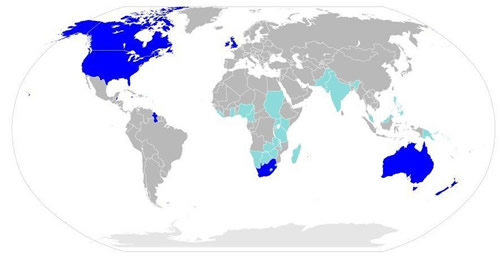
    English is spoken as first language by more than 370 million people throughout the world, and is used as a second language by as many, if not more. One in five of the world's population speaks English with some degree of competence. It is an official or semi-official language in over 70 countries, and it plays a significant role in many more. English is not just one standard language, but can be thought of as a "family", which includes many different varieties. The map below shows where English and its varieties are spoken nowadays: 
   countries with significant concentrations of native speakers of English (in all of these countries English is an official or de facto language of administration)
   other countries in which English is an official or important administrative language
Source: Wikipedia, the free Encyclopedia (http://en.wikipedia.org/wiki/Main_Page)

    Within a decade, 2 billion people will be studying English and about half the world — about 3 million people — will speak it. Non-native speakers of the language now outnumber native speakers 3 to 1, according to English language expert David Crystal. He recognizes that there is never before been a language that's been spoken by more people as a second language than a first. In Asia alone, the number of English-users has topped 350 million — roughly the combined populations of the United States, Britain and Canada. There are more Chinese children studying English — about 100 million — than there are Britons.
   
What people use English for
    The massive English-learning industry in India alone is a $100 million-per year business. It's the front line of a global revolution in which hundreds of millions of people are learning English, the planet's language for almost every kind of transaction. English is the main language of commerce, technology, communication, science, academic conferences, business, entertainment, airports and air-traffic control, diplomacy, radio, newspapers, books, sports, tourism, international competitions, pop music advertising etc. — and, increasingly, empowerment.
     Over two-thirds of the world's scientists read in English. Three quarters of the world's mail is written in English. Eighty per cent of the world's electronically stored information is in English. Of the estimated forty million users of the Internet, some eighty per cent communicate in English, but this is expected to decrease to forty per cent as speakers of other languages get online.